

You did everything right. You applied, you waited, and the letter still said no. Now you're staring down a 60-day clock, wondering if appealing is even worth it — or if this is just how it goes for everyone.
If you didn't know this already: the system that took months to deny you is the same system that can approve someone else in two weeks flat. Same SSA, same rules, wildly different speed — and once you see why, you'll know exactly where your appeal actually stands.
Same System, Two Speeds
I've been on both sides of this. My own SSDI claim was approved in two weeks because it qualified under Compassionate Allowances — a program that fast-tracks claims for conditions the SSA already knows meet its disability standard. I've also had a claim correctly denied years earlier, back when I didn't meet that bar. Same agency, same rulebook, two completely different timelines.
If you're reading this, you're probably not in the fast lane. You're in the lane most people are in: the one where the SSA looked at your file and said the evidence wasn't clear enough yet. That's not a verdict on whether you're disabled. It's a statement about what's currently in your file.
What Your Denial Speed Is Actually Telling You
A fast approval usually means your condition is on a list the SSA already treats as clear-cut, or your medical records left no real question to resolve. A slow denial usually means the opposite: something in your case is subjective, incomplete, or open to interpretation — not necessarily wrong, just not yet proven on paper.
That distinction matters because it changes what you should focus on. If your case is contested, the appeal isn't about resubmitting the same file and hoping for a different reviewer. It's about closing the specific gap that got you denied in the first place.
The Four-Step Ladder
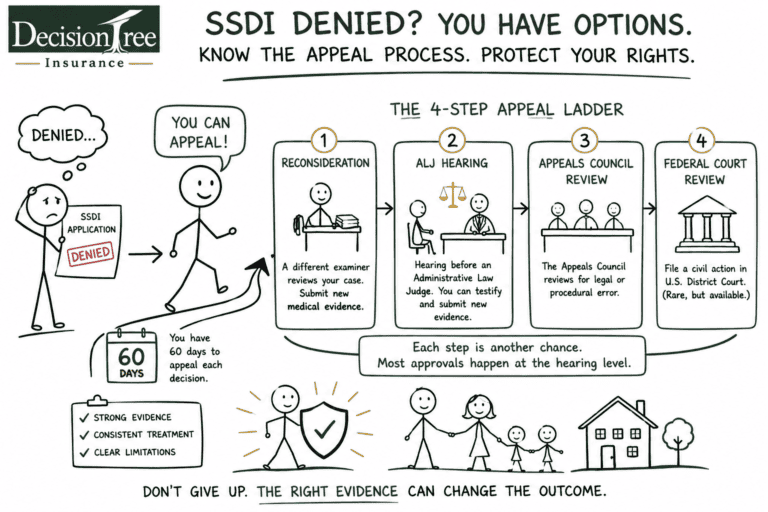
The SSA gives you four levels of appeal if you disagree with a decision. You don't have to know all four today — you only need to know the one in front of you — but seeing the whole ladder helps you understand where you stand.
1. Request for Reconsideration. This is a reconsideration — a fresh, complete review of your claim by a different examiner at your state's Disability Determination Services office, someone who had no part in the original decision. You have 60 days from the date on your denial letter to file. This is your chance to add new medical evidence, not just resubmit the old file.
2. ALJ Hearing. If reconsideration is denied, you can request a hearing before an Administrative Law Judge (ALJ) — an independent judge, unconnected to your earlier reviews, who holds an informal hearing in person or by video. You can testify, bring a doctor or vocational expert, and submit new evidence before the hearing date. This is also where most appeal-stage approvals actually happen, because it's the first time a live person hears your case rather than just reviewing a file.
3. Appeals Council Review. If the ALJ denies you, the Appeals Council — the SSA's final internal review body — can review the judge's decision for legal or procedural error. It doesn't re-hear your case from scratch; it checks whether the ALJ applied the rules correctly.
4. Federal Court Review. If the Appeals Council denies or declines to review your case, your final option is filing a civil action in U.S. District Court. Very few claims reach this stage, but it exists.
The clock resets at every stage. You get 60 days from each decision to file the next appeal. Miss it, and in most cases you have to start the entire application over — losing your original filing date and any back pay tied to it.
Where Mental Health Claims Sit in This Ladder
Some conditions move through this ladder more often than others, and mental health claims are near the top of that list. Depression, anxiety, PTSD, and similar conditions don't show up on a scan or a bloodwork panel — the evidence has to come from consistent treatment records and a provider willing to document how the condition limits your ability to function. That's a much higher bar to clear on paper than a condition with an objective test behind it.
If that's your situation, this breakdown of why mental health SSDI claims get denied more — and what actually changes that goes much deeper into the specific evidence gaps and how to close them before your next appeal deadline.
What Actually Moves the Needle on Appeal
Consider Maria, a composite of claimants I've seen go through this process. Her initial application was denied because her file only had visit notes from a general practitioner — no specialist input, no functional limitations spelled out. Between her denial and her hearing, she got a written statement from her treating psychiatrist that specifically addressed what she could and couldn't do in a work setting, not just her diagnosis. That single document reframed her entire case, because it answered the question the SSA actually asks: not "does she have this condition," but "does this condition stop her from working."
A few things consistently move an appeal forward:
- New or updated medical evidence — especially records dated after your original denial
- A treating provider's written opinion on your specific functional limitations, not just a diagnosis
- Consistency between your treatment history and what you're claiming you can't do
- Any documentation of side effects, missed work, or accommodations tied directly to your condition
None of this guarantees an approval. But it's the difference between resubmitting the same story and giving the next reviewer a genuinely stronger file to work from.
Closing the Loop
Whether your claim moves in two weeks or two years, it's being measured against the same standard the whole way through. Speed isn't favoritism — it's a reflection of how clear-cut the evidence was on day one. A slow, contested case isn't a broken system working against you. It's the same system asking for more proof before it commits.
Once you know which lane you're in, you know exactly what to spend your energy on: not waiting, but building the file that answers the question your denial letter actually raised.
For the fuller picture of how SSDI is structured — claiming strategy, survivor benefits, and the rest of this series — visit the Social Security hub.
Frequently Asked Questions
How long do I have to appeal an SSDI denial?
You have 60 days from the date you receive your denial letter to file the next level of appeal. The SSA generally assumes you received the letter 5 days after the date printed on it, unless you can show otherwise.
What's the difference between reconsideration and an ALJ hearing?
Reconsideration is a paper review by a different examiner at your state's disability office. An ALJ hearing is a live, informal hearing before an independent judge, where you can testify and bring evidence in person or by video.
Do I need a lawyer or representative to appeal?
It's not required at any stage, but many claimants bring a representative once they reach the ALJ hearing level, where presenting evidence and testimony effectively starts to matter more.
How long does each appeal stage take?
Reconsideration is typically the fastest stage. ALJ hearings generally take the longest, since they involve scheduling a live hearing and a judge's written decision afterward. Timelines vary significantly by region and current SSA caseloads.
If mental health claims get denied more, does that mean mine will be too?
Not necessarily — it means the evidence bar is higher, not that approval is unlikely. This companion article walks through exactly what strengthens a mental health SSDI claim at each stage.